


EP 003: The Science & Spirit of Synchronicity

Updated: Apr 2
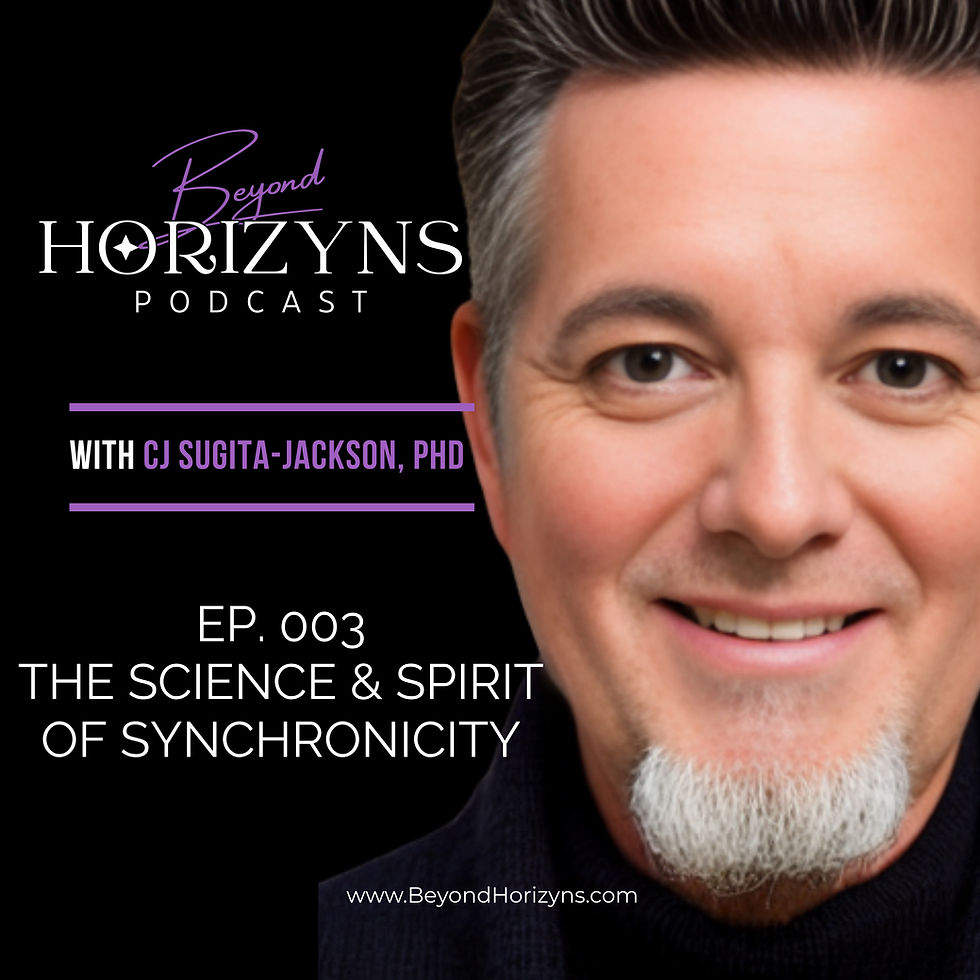
BEYOND HORIZYNS PODCAST
Episode Script — Production Ready
Episode 003 | The Science and Spirit of Synchronicity
Host: CJ Sugita-Jackson, PhD | Est. Runtime: 20–28 minutes
[ HOOK — COLD OPEN, NO MUSIC ]
What if the moment you thought about someone — and they called you — wasn't a coincidence?
What if the book that fell off the shelf at exactly the right time... wasn't an accident?
What if the repeated numbers you keep seeing, the unexpected meetings, the uncanny timing — what if those things were actually telling you something real?
I'm not asking you to believe in magic right now. I'm actually asking you to consider something more interesting than that — I'm asking you to consider what science has to say.
Because it turns out... the universe may be more connected than we've been taught. And the experience we call synchronicity sits right at that fascinating edge between psychology, quantum physics, and something much older WISDOM — wisdom that humans have always felt but rarely had language for.
Today, we're going to go there. Together.
🎵 MUSIC INTRO — Full theme plays in / fade down after 20–30 seconds
[ WELCOME — SHOW OVERVIEW ]
Welcome to Beyond Horizyns.
I'm CJ Sugita-Jackson — and this podcast is a space for people who are curious. People who don't want to choose between ancient wisdom and modern understanding. People who believe that wellness, spirituality, metaphysics, and real, grounded living aren't separate paths — they're different expressions of the same journey.
Every week on this show, we're going to explore ideas, traditions, and perspectives that live at the intersection of the spiritual and the scientific, the personal and the universal, the timeless and the deeply relevant right now.
We're not here to tell you what to believe. We're here to give you better questions — and better tools to find your own answers.
One thing I care deeply about on this show is grounding every conversation in reality. That means when we talk about metaphysical or spiritual experiences, we're also going to look at what the research says, what the science shows, and what we actually know — versus what's being sold to us.
Because there's a lot of noise out there. And I want this to be a place you can trust.
So — welcome. I'm really glad you're here.
🎵 MUSIC TRANSITION — Brief, smooth, settling
[ HORIZYNS PLATFORM PROMO ]
Before we dive in, I want to take a moment to tell you about something that's been in the works — something I genuinely believe is going to change the way people in the holistic, spiritual, and wellness space find each other, support each other, and grow together.
It's called Horizyns.
Horizyns is a platform our team has been building for creators, practitioners, healers, teachers, and seekers like you — an all-in-one space where you can discover amazing holistic and wellness vendors, take workshops and classes, find meaningful products, connect with a real community, and build something of your own if you're a creator in this space.
Think of it as a conscious, curated ecosystem — part marketplace, part learning platform, part community hub. Built with intention, for people who want more than just an algorithm.
Horizyns is launching in 2026, and right now you can get ahead of it.
Head over to www.horizynsinc.com — that's H-O-R-I-Z-Y-N-S-I-N-C dot com — to learn more or schedule a personal demo of the platform. I would love to walk you through what we're building and show you how it could serve you — whether you're a seeker, a creator, or both.
The link is in the show notes. Go take a look. I think you're going to love what's coming.
🎵 MUSIC TRANSITION — Slightly more curious, curious energy building
[ MAIN CORE DISCUSSION — THE SCIENCE AND SPIRIT OF SYNCHRONICITY ]
PART ONE: What Is Synchronicity — And Why Does It Matter?
Let's start with the word itself.
Synchronicity. It was coined by the Swiss psychiatrist Carl Gustav Jung in the early 20th century. Jung described it as a meaningful coincidence — a moment where two events that have no obvious causal connection seem to be meaningfully related.
Not just weird timing. Not just coincidence. But something that feels... significant. Something that carries meaning beyond the randomness of chance.
Jung spent decades studying these moments. He recorded them in his patients, in himself, and in the broader patterns of human experience. He believed synchronicity was a fundamental principle of reality — not just a psychological curiosity.
And here's where it gets really interesting.
Jung didn't come up with this idea in isolation. He developed it in close collaboration with one of the most respected physicists of the 20th century — Wolfgang Pauli. Yes — a Nobel Prize-winning physicist was deeply fascinated by this same phenomenon.
Their collaboration led to a paper called 'The Interpretation of Nature and the Psyche' — published in 1952 — in which Jung and Pauli explored whether there was a deeper ordering principle in the universe that connected inner experience and outer events.
That's definitely not woowoo. That's two serious scientific minds asking a serious question.
PART TWO: The Psychology Behind the Experience
Now, modern psychology has something to say here too — and I think it's worth being honest about both sides.
There's a well-documented phenomenon called the Baader-Meinhof effect — also known as the frequency illusion. This is when you notice something for the first time — maybe a word, a car, a name — and then suddenly you start seeing it everywhere.
What's actually happening is a cognitive process. Your brain's reticular activating system — the part of your brain that filters what you pay attention to — gets activated. Once something is on your radar, your brain literally starts filtering for it more.
So part of synchronicity, from a psychological standpoint, may be about selective attention. We notice what we're primed to notice.
But here's the thing — and this is where I think the conversation gets really rich — that explanation doesn't fully account for the depth of the experience. It doesn't explain the specific emotional weight of synchronistic moments. It doesn't explain Jung's documented cases, or the way certain synchronistic experiences seem to cluster around major life transitions.
The psychologist Gary Schwartz at the University of Arizona has done research suggesting that some coincidences are statistically improbable enough that selective attention alone doesn't fully explain them.
So we have a layered picture: Yes, cognitive bias plays a role. AND there may be something more happening that we don't yet fully understand.
Hold that tension. It's a good place to be.
PART THREE: What Quantum Physics Suggests
Now let's go somewhere that might surprise you.
In quantum physics, there's a phenomenon called quantum entanglement. It was famously called 'spooky action at a distance' by Einstein — and he didn't mean it as a compliment. He was skeptical.
But here's what quantum entanglement actually is: when two particles become entangled, they remain connected regardless of the distance between them. When you observe the state of one particle, the other particle — instantaneously — reflects a correlated state. No signal passes between them. It just... happens.
This has been proven in laboratory experiments, most notably the Bell Test experiments, first conducted by physicist John Bell in the 1960s and refined many times since. The results consistently support entanglement as a real, observable phenomenon.
Now — I want to be careful here, because this is where some people stretch the science in ways that aren't honest. Quantum entanglement does NOT mean that thinking about someone telepathically sends them a message. The physics doesn't directly map onto human consciousness that way. Anyone telling you that is oversimplifying or misrepresenting the science.
But what it DOES suggest — and what physicists like David Bohm explored through his theory of the Implicate Order — is that reality may have a deep structure of connectedness that we don't normally perceive. That beneath the surface of separate, isolated events, there may be a unified field of information.
Bohm called this the Implicate Order — the idea that the universe enfolds a kind of wholeness that our physical senses only partially reveal.
That's one of the most serious theoretical physicists of the 20th century describing reality.
And suddenly Jung's question — is there a principle that connects inner experience and outer events — doesn't sound so strange.
PART FOUR: Ancient Traditions Already Knew This
Now, This is not a new idea.
Ancient Chinese cosmology has the concept of li — the principle that all things in the universe are interconnected through pattern and correspondence. The I Ching — the Book of Changes — which dates back over three thousand years — is built on the understanding that a moment in time carries meaning, and that the inner and outer worlds mirror each other.
In indigenous traditions across the globe — from Andean cosmology to West African thought to Native American spiritual practice — there is a profound understanding that the world is alive, communicative, and responsive. That the appearance of a certain animal, a shift in weather, or an unexpected encounter is not meaningless noise. It is part of a larger conversation.
In Vedic and Hindu philosophy, the concept of Indra's Net describes the universe as an infinite web of jewels, each one reflecting every other. A metaphor for radical, seamless interconnection.
These traditions weren't primitive guesses. They were the result of thousands of years of careful, attentive, deeply human observation of the world.
What modern science is beginning to approach — these traditions were already living.
PART FIVE: How to Work With Synchronicity Practically
So what do we actually do with this?
Because I don't want this to stay theoretical. One of the things I believe deeply about this kind of exploration is that wisdom has to land in your life. It has to become something you can use.
Here's my practical framework for working with synchronicity in a grounded, healthy way.
First — notice without grasping. When something feels synchronistic, pause. Acknowledge it. Don't immediately assign an elaborate meaning. Just be curious. Ask: what might this be pointing toward?
Second — keep a synchronicity journal. This is something I genuinely recommend. Write down the moments that feel meaningful — the unexpected connections, the timely arrivals, the uncanny repetitions. Over time, patterns emerge that you simply cannot see in the moment.
Third — look at what was happening in your inner world when the synchronicity occurred. Jung noticed that synchronicities often cluster around periods of heightened emotional significance — grief, transition, deep desire, spiritual opening. Your inner state and outer experience may be more related than you've been taught to believe.
Fourth — don't manufacture meaning where there isn't any. This is the honest part. Not every coincidence is synchronicity. Sometimes things are just... things. The goal is discernment, not magical thinking. The goal is awareness, not obsession.
And fifth — act on what resonates. If a synchronistic moment points you toward a conversation, a path, a practice, a person — consider taking the step. Not blindly. But with open-eyed curiosity.
Synchronicity, at its best, is an invitation to pay closer attention to your life.
🎵 MUSIC TRANSITION — Warm, grounding, gentle
[ SPONSOR SPOTLIGHT — TEA4PEACE TRANQUILITEA LOUNGE ]
This episode of Beyond Horizyns is brought to you by Tea4Peace TranquiliTea Lounge — my own ritual-centered tea and botanical wellness brand.
We just spent time talking about the power of being present, of slowing down enough to notice what's actually happening around you and within you. And that's exactly what a tea ritual is designed to do.
Tea4Peace is built around the idea that tea is more than a beverage. It's a practice. It's a moment of intentional pause. It's herbal wisdom in a cup.
You can find more about Tea4Peace in the show notes. I'd love for you to explore what's there.
🎵 MUSIC TRANSITION — Returning, reflective, closing energy
[ FINAL REFLECTION — SUMMARY AND SYNTHESIS ]
Alright, Let's bring this home.
Today we explored synchronicity — that beautiful, strange, deeply human experience of meaningful coincidence. And what we found is this:
Carl Jung named it. Wolfgang Pauli took it seriously as a physicist. Modern psychology has given us tools like the Baader-Meinhof effect to understand the cognitive side of it. Quantum physicists like David Bohm have pointed toward a deep structural connectedness in reality itself. And ancient traditions across the globe have been living with this understanding for thousands of years.
The honest answer is: we don't have a complete scientific explanation for synchronicity yet. Anyone who tells you they do — whether they're selling you quantum crystals or a certified synchronicity course — be skeptical.
But dismissing these experiences as meaningless isn't honest either. The science is genuinely curious. The traditions are genuinely wise. And the experience itself — that feeling of the universe winking at you — is real.
What I want you to take away today is permission. Permission to notice. Permission to wonder. Permission to ask the question without needing a tidy answer right now.
Because that permission — that open, curious, grounded awareness — is itself a spiritual practice. And it doesn't cost you anything. It just asks you to pay attention.
🎵 MUSIC TRANSITION — Warm closing theme rises gently
[ CALL TO ACTION AND CLOSING ]
If you enjoyed this episode, please be sure to follow the Beyond Horizyns podcast wherever you're listening right now — so you never miss a future conversation.
And I want to invite you to join our Horizyns community at www.horizynsinc.com — that's H-O-R-I-Z-Y-N-S INC dot com — where you can meet like-minded individuals, discover amazing products, and take workshops from our many curated vendors.
Each week on this show, we'll keep exploring new ideas, traditions, and perspectives — things that can genuinely help us live more balanced, more meaningful, more intentional lives.
Thank you for being here at the beginning of this journey. It means more than you know.
And until next time — keep exploring what lies beyond the horizon.
SHOW NOTES REFERENCE
Key People & Concepts to Reference:
• Carl Gustav Jung — coined synchronicity, 'The Interpretation of Nature and the Psyche' (1952)
• Wolfgang Pauli — Nobel Prize-winning physicist, co-author with Jung
• Baader-Meinhof Effect / Frequency Illusion — cognitive psychology
• Gary Schwartz — University of Arizona, research on meaningful coincidence
• Quantum Entanglement — Bell Test experiments (John Bell, 1960s)
• David Bohm — Implicate Order, 'Wholeness and the Implicate Order' (1980)
• Indra's Net — Vedic/Buddhist cosmology
• I Ching — Chinese Book of Changes, 3,000+ years old
Links for Show Notes:
• Horizyns platform preview: www.horizynsinc.com
• Tea4Peace TranquiliTea Lounge: www.Tea4Peace.org
• Horizyns community: www.horizyns.com


Comments